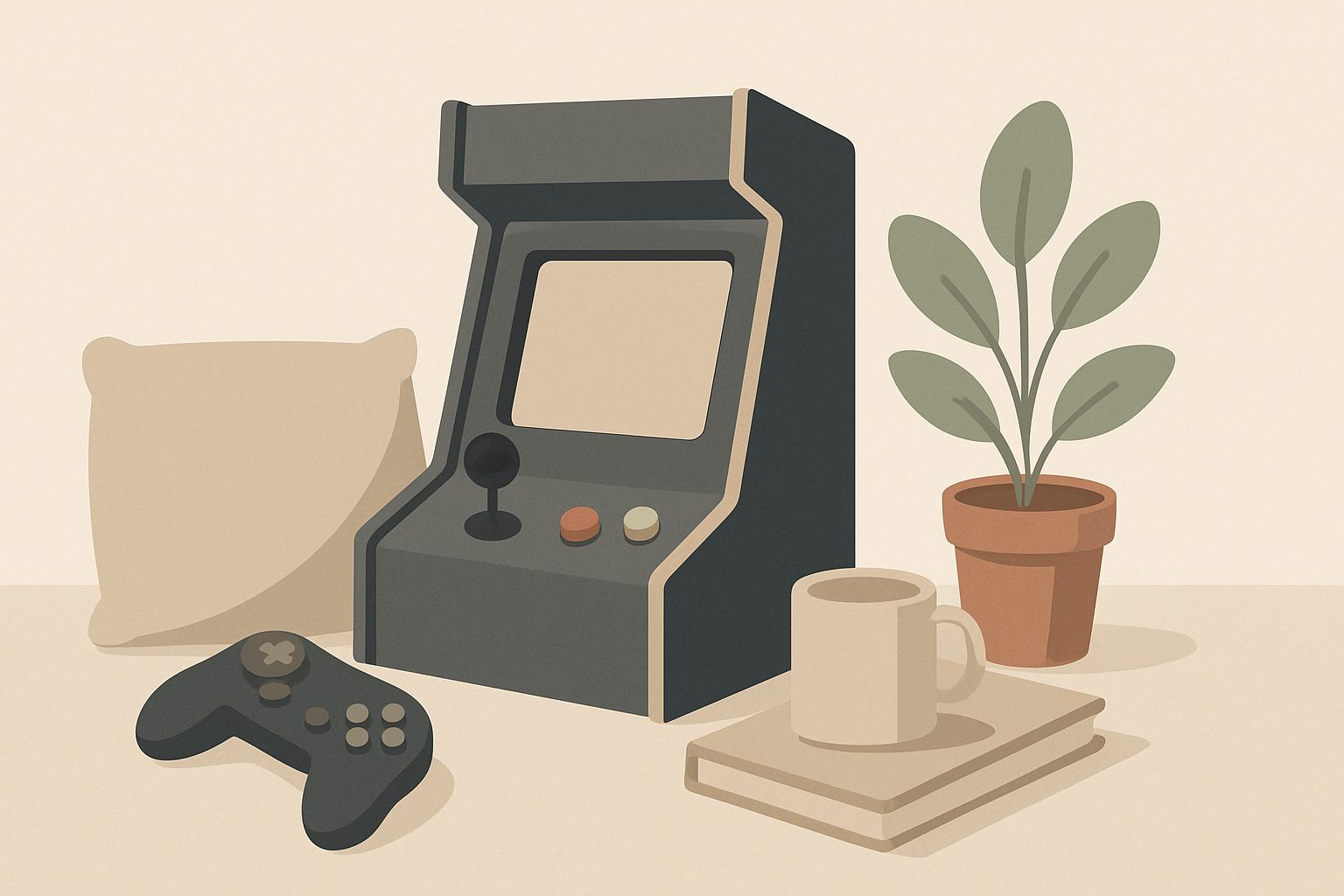
Plug-and-Play vs Build-Your-Own Arcade Machine UK: Which Is Right for You?
The home arcade revival is thriving in the UK, and you've got two fundamentally different routes to join it. Plug-and-play machines — sealed cabinets that work out of the box — offer instant gratification and zero fuss. Building your own, usually around a Raspberry Pi or PC, demands time and tinkering but gives you complete control. The choice hinges on what you actually want from your arcade: a finished showpiece or a bespoke gaming platform.
Plug-and-Play Arcade Machines: Turnkey Convenience
Plug-and-play cabinets arrive assembled and ready to use. You unbox, find a space, plug in power and a joystick, and start playing. Models like the Arcade1Up range (widely available in the UK) contain 100–200 built-in games, whilst some specialist brands pack dozens of authentically licensed titles.
What You're Paying For
A decent plug-and-play machine costs £200–600 depending on size and game selection. Arcade1Up cabinets typically sit around £300–500; licensed arcade cabinets (eg, Pac-Man, Street Fighter branded units) push toward £400–600. You're paying for the cabinet itself, the pre-loaded game library, and the convenience of having someone else handle the technical integration.
Strengths
Plug-and-play machines require zero technical knowledge. There's no soldering, no Linux command line, no emulator configuration. You get a consistent, tested experience; Arcade1Up's library has been curated and tested by the manufacturer. The games run reliably, aesthetics are polished, and it's genuinely a low-friction entry point. If you want an arcade machine for casual family gaming or a nostalgic conversation piece, this is the path of least resistance.
They're also compact — most upright cabinets occupy a footprint of roughly 60cm × 60cm, fitting a corner of a living room or games room without dominating it. The visual appeal is immediate: they look like miniature arcade cabinets, and that retro aesthetic carries weight.
Weaknesses
Game libraries are fixed. You cannot add new games, swap emulators, or customise what's available — you're limited to what the manufacturer pre-loaded. If you discover later that you want to play a specific game or a game from a different era, you're out of luck without buying a different cabinet.
Upgrades and repairs can be problematic. If the joystick wears out or you want to swap for a higher-quality control panel, you may find parts hard to source or expensive to replace. The hardware inside is proprietary, making independent repairs or modifications difficult.
Longevity is uncertain. Some plug-and-play machines have reliability issues; the joysticks and buttons wear quickly with heavy use, and the pre-loaded game experience can feel dated or limited after a few months of ownership.
Build-Your-Own: Flexibility and Control
A DIY arcade machine is typically built around a single-board computer (usually a Raspberry Pi 4 or Pi 5) running emulation software like RetroPie or Batocera. You source a cabinet (flat-pack MDF kits are common in the UK), wire in joysticks and buttons, mount the Pi, and configure the software. Alternatively, you can build around a PC for more powerful emulation or even access to modern indie games.
What You're Paying For
A DIY build costs £300–800 depending on your choices. A decent flat-pack cabinet kit (from UK suppliers like Arcade Warrior or custom MDF builders) runs £150–300. A Raspberry Pi 4 is around £60–80. A decent joystick and button set (Sanwa clones, widely available online) costs £80–150. Then add smaller components: a monitor or display (£50–150, used options cheaper), USB controllers, power supplies, and wiring. You're paying for components, not convenience.
Strengths
Game library is limitless. You can run thousands of games across dozens of emulated systems — from Atari 2600 through to N64, arcade classics, and beyond. You control every game installed and can swap them out anytime. This flexibility means your arcade machine grows with your interests rather than being locked down.
Upgradeability is the real advantage. Wear out your joystick? Buy a replacement and swap it. Want a better monitor? Do it. Want to add a second player control panel? Possible. Want to switch to a PC for better 3D emulation? You can rebuild without losing the cabinet.
The cost-per-game is negligible. Once built, adding a thousand more games costs nothing. If you're a completionist, you can have an arcade experience that would cost thousands of pounds to achieve with original arcade hardware.
Weaknesses
Technical skill and time are non-negotiable. You need to be comfortable with a soldering iron, comfortable configuring Linux, and patient with troubleshooting. The initial build takes a weekend minimum; configuration takes longer if you want a polished interface.
Legal clarity is murky. Emulation itself is legal; the game ROMs are not (with exceptions for abandonware). Most home builders accept this grey area, but you're aware you're distributing copyrighted content privately.
Quality control is your responsibility. The software and hardware experience depends entirely on your setup. If you misconfigure something, performance might stutter or controls might feel imprecise. You own the debugging.
Key Considerations
Game Library Flexibility: If you know exactly which games you want and they're in the plug-and-play's pre-load, that's fine. If you're uncertain or want access to obscure titles, DIY wins.
Time and Skill: Plug-and-play wins if you want to play this week. DIY requires 40–60 hours across build, configuration, and refinement.
Upgradeability: DIY is upgradeable; plug-and-play is not.
Space and Aesthetics: Plug-and-play cabinets are finished and polished visually. DIY requires you to source or build an attractive cabinet; some look fantastic, others look rough.
Cost Ceiling: Both start similarly, but DIY can remain affordable as you add games (free), whilst plug-and-play costs compound if you want multiple cabinets.
Which Path Is Right for You?
Choose plug-and-play if you want an arcade machine that looks professional, requires no tinkering, and you're happy with a fixed game selection. It's a finished product, not a project.
Choose build-your-own if you're comfortable with technical work, want access to thousands of games, intend to upgrade or maintain the machine yourself, and you view it as an ongoing hobby rather than a purchase.
Most UK enthusiasts end up DIY because the cost-to-library ratio favours it long-term, but plug-and-play has a real place if you value convenience and finished quality over flexibility.
More options
- Home Arcade Machines (General) — Amazon UK (Amazon UK)
- Raspberry Pi Arcade Cabinet Kits — Amazon UK (Amazon UK)
- Arcade Joysticks & Button Sets — Amazon UK (Amazon UK)
- Cocktail Arcade Tables — Amazon UK (Amazon UK)
- Arcade Machine Accessories (Stools, Covers, LED) — Amazon UK (Amazon UK)